

Customization Insights from LST, a China Leading Custom Chocolate Mold Supplier for Modern Confectioners

In the quiet focus of an artisanal kitchen or the rapid pulse of a commercial confectionery factory, the transition from melted chocolate to a finished bar requires precise thermal control and physical shaping. An artisan chocolatier pours a batch of freshly tempered chocolate into a set of standard off-the-shelf trays. As the cooling tunnel completes its cycle, an all-too-familiar operational bottleneck surface: intricate geometric details fail to release cleanly from the cavities, while minor height discrepancies across the tray lead to subtle variations in piece weight. For growing confectionery businesses attempting to scale operations, standard generic tooling often limits throughput and compromises final product consistency. Serving as a China leading custom chocolate mold supplier, Chengdu LST Science and Technology Co., Ltd. addresses these operational challenges by offering an integrated design and engineering perspective that bridges artistic product concepts with mechanical production lines.
The engineering required for high-volume confectionery manufacturing extends far beyond simple cavity shapes. Achieving an unblemished surface gloss, structural integrity, and predictable release characteristics demands complete synchronization between mold geometry, substrate properties, and depositor machine mechanics. When equipment designers analyze thermal transfer profiles and mechanical stress points during demolding, they can develop custom tooling configurations that minimize manual labor, lower scrap rates, and optimize machine uptime across full production shifts.
Material Selection Guide: Rigid Polycarbonate vs. Food-Grade Silicone
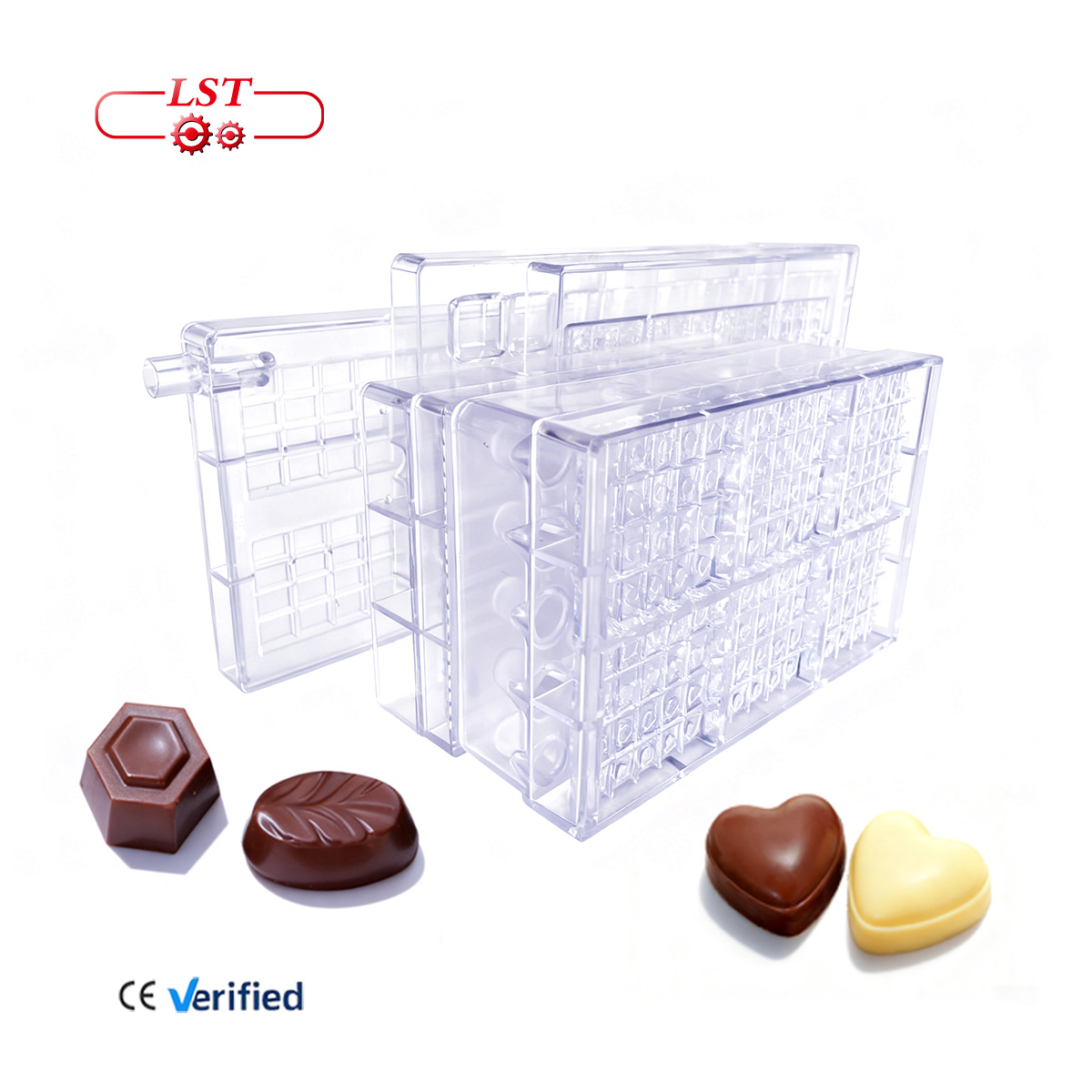
Selecting an appropriate material foundation represents the foundational engineering decision in custom mold development. High-grade polycarbonate chocolate mold choices remain the primary industrial standard for high-capacity, fully automated production lines. Rigid polycarbonate offers exceptional dimensional stability and high impact strength, which allows mechanical knock-out arms and line vibrators to operate continuously without flexing or fatiguing the mold frame. Furthermore, the glass-like interior surface finish of a premium polycarbonate mold promotes uniform cocoa butter crystallization during the cooling phase. This precise crystallization yields the desirable surface gloss and crisp snap that consumers expect from premium chocolate bars.
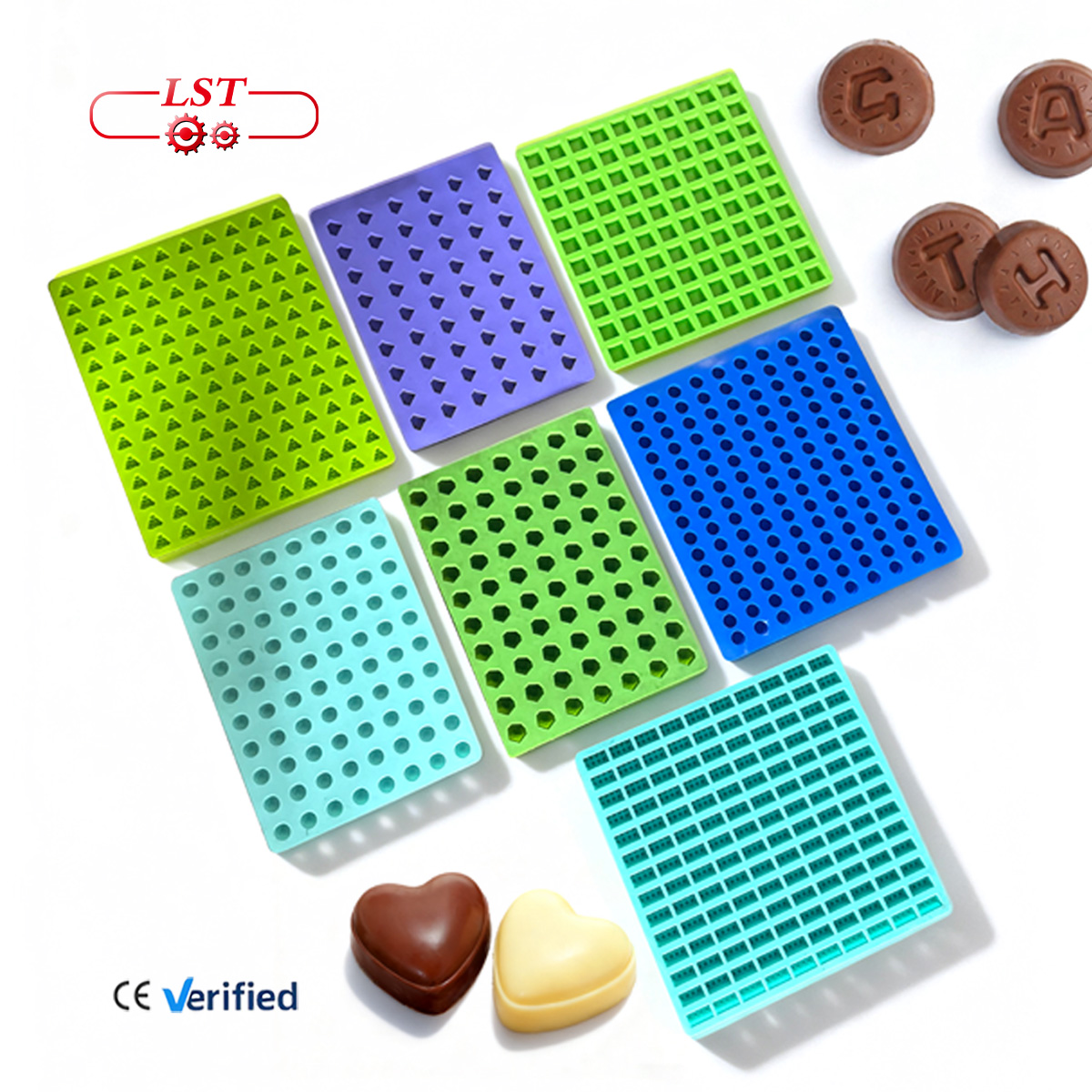
In comparison, food-grade silicone mold tooling provides specific advantages for specialized confectionery products and flexible production setups. Formulated to comply with FDA and LFGB food contact standards, high-purity silicone resins tolerate extreme temperature fluctuations ranging from minus 40 degrees Celsius in blast freezers up to 230 degrees Celsius in hot prep stations. The natural elasticity of silicone simplifies manual demolding for delicate three-dimensional figurines, deep undercuts, or complex multi-layer pieces containing soft centers. Chengdu LST Science and Technology Co., Ltd. conducts comprehensive technical assessments of every client's cooling equipment, handling methods, and target volume before recommending a substrate, ensuring that manufacturers invest in functional, long-lasting assets suited to their specific operational reality.
The Customization Workflow: From Concept Design to Trial Validation
Transforming a creative confectionery concept into a dependable factory-floor component follows an exact engineering workflow. The custom design process at Chengdu LST Science and Technology Co., Ltd. begins when a client provides initial 2D vector drawings, 3D CAD models, or physical product samples. Design engineers analyze these inputs to determine optimal draft angles, wall thicknesses, and internal volumetric distribution to guarantee consistent piece weight across every cavity.
1.Initial Vector and CAD Review: Technical teams refine submitted 2D and 3D schematics to adjust cavity draft angles, corner radii, and fill volumes, ensuring that every finished chocolate piece meets precise target weight specifications.
2.Magnetic Alignment Integration: For high-speed automated depositor lines, specialized magnetic positioning pin sockets are engineered into the frame structure to lock the mold securely against carrier tracks and prevent alignment drift.
3.Prototype Sampling: Functional trial molds are manufactured in polycarbonate or food-grade silicone to evaluate real-world liquid fill patterns, air evacuation, and thermal shrinkage rates during test runs.
4.Surface and Shrinkage Inspection: Sample pieces undergo dimensional measurements and visual surface checks to verify that cavity dimensions match exact specifications before full-scale manufacturing commences.
A critical engineering enhancement in commercial mold manufacturing involves integrated magnetic positioning technology. Magnetic molds incorporate internal metal plates or precision-aligned magnetic pin sockets designed to interface directly with carrier frames on automated depositing lines. This structural integration eliminates tiny alignment drifts caused by continuous machine vibrations, protecting delicate depositor nozzles from collision damage and misfeeds. Once prototype samples satisfy all surface gloss, dimensional accuracy, and thermal shrinkage criteria, mass production tooling begins.
Achieving Synergy Between Mold Tooling and Depositor Lines
Custom molds deliver maximum operational value when their physical dimensions match the exact mechanical specifications of the receiving depositor machinery. Off-the-shelf generic trays frequently suffer from nozzle pitch mismatch, where cavity centers do not align precisely with the depositor's discharge nozzles. This misalignment results in edge drips, contaminated mold margins, and uneven weight distribution across a batch.
When designing custom units, LST calculates the exact nozzle spacing of benchtop depositors, commercial units, or fully automated production lines to align cavity centers accurately. Furthermore, mold wall thickness is calibrated to match the cooling tunnel temperature gradient. Polycarbonate density directly impacts heat conduction as liquid cocoa butter transitions from a liquid phase to a stable crystalline state. Aligning mold wall thickness with cooling tunnel airflow speeds up heat transfer, shortens tunnel retention time, and helps prevent fat bloom formation on finished products.
Elevating Operational Efficiency Through Precision Engineering
Custom tooling represents much more than a method for stamping a brand logo onto a chocolate bar. When designed with an understanding of machine mechanics, material science, and cooling dynamics, a custom mold functions as an essential component for production line optimization. By combining precise cavity placement, thermal calibration, and durable material options, chocolate manufacturers can achieve consistent product quality alongside higher operating speeds.
As a specialized chocolate mold supplier, Chengdu LST Science and Technology Co., Ltd. integrates machinery design expertise with custom mold manufacturing. This double-layered technical focus assists confectionery producers in transitioning smoothly from small batch operations to high-speed commercial production.
To explore custom tooling options, machinery compatibility, and technical specifications, visit the official website: https://www.lst-machine.com/
Chengdu LST Science and Technology Co., Ltd.
Chengdu LST Science and Technology Co., Ltd.
+ +86177 8051 0820
email us here
Visit us on social media:
Facebook
YouTube
Legal Disclaimer:
EIN Presswire provides this news content "as is" without warranty of any kind. We do not accept any responsibility or liability for the accuracy, content, images, videos, licenses, completeness, legality, or reliability of the information contained in this article. If you have any complaints or copyright issues related to this article, kindly contact the author above.
