

Global Natural Cosmetics Market to Hit USD 96.4 billion by 2036, Led by L’Oréal, Unilever & Estée Lauder
Natural Cosmetics Market
Global market grows at 5.7% CAGR, led by North America & Europe, with L’Oréal, Unilever & Estée Lauder driving clean beauty innovation
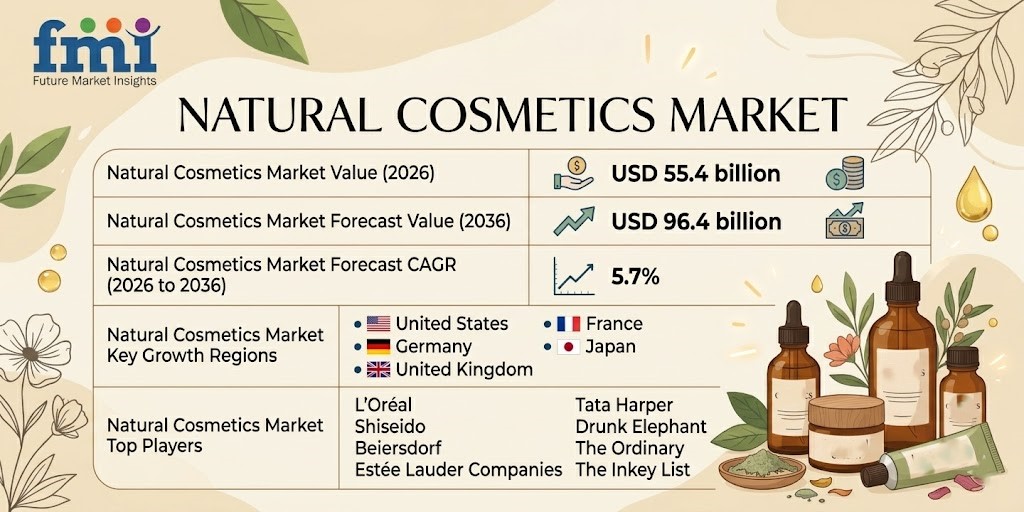
NEWARK, DE, UNITED STATES, March 27, 2026 /EINPresswire.com/ -- The global natural cosmetics market is poised for steady growth over the next decade, expanding from USD 55.4 billion in 2026 to USD 96.4 billion by 2036, registering a CAGR of 5.7%. Market expansion is driven by increasing consumer preference for plant-based, organic, and minimally processed personal care products, alongside growing awareness of chemical sensitivities and sustainability concerns.
The shift toward clean beauty and environmentally responsible consumption is reshaping the cosmetics industry. Natural cosmetics, formulated with botanical extracts, essential oils, and bioactive compounds, are gaining traction as safer and more sustainable alternatives to conventional products.
Natural Cosmetics Market Snapshot (2026–2036)
• Market size in 2026: USD 55.4 billion
• Market size in 2036: USD 96.4 billion
• CAGR (2026–2036): 5.7%
• Leading ingredient type: Herbal (~42% share)
• Dominant product category: Skin care (~38% share)
• Key growth regions: North America, Europe, Asia-Pacific
• Fastest-growing countries: United States, Germany, United Kingdom, France, Japan
Request For Sample Report | Customize Report |purchase Full Report – https://www.futuremarketinsights.com/reports/sample/rep-gb-8588
Market Momentum
The natural cosmetics market begins at USD 55.4 billion in 2026 and demonstrates consistent growth throughout the forecast period. By 2031, the market surpasses USD 69 billion, driven by rising consumer awareness, expansion of retail and e-commerce channels, and growing demand for certified natural products.
Between 2031 and 2036, growth accelerates as premium formulations, innovative botanical ingredients, and sustainable packaging gain traction. By 2036, the market reaches USD 96.4 billion, maintaining a steady CAGR of 5.7%.
Why the Market Is Growing
Growth in the natural cosmetics market is fueled by increasing consumer demand for safer, chemical-free personal care products. Concerns over synthetic ingredients, preservatives, and allergens are encouraging a shift toward natural alternatives.
Consumers are prioritizing ingredient transparency, ethical sourcing, and sustainability. At the same time, manufacturers are innovating with clinically validated formulations, combining efficacy with natural ingredients to meet evolving expectations.
Additionally, the rise of wellness-oriented lifestyles and clean-label trends is driving adoption across skincare, haircare, and cosmetic segments, supported by strong growth in online and specialty retail channels.
Segment Spotlight
Product Type: Skin Care Leads with ~38% Share
Skin care dominates the market due to its high usage frequency and strong consumer focus on hydration, anti-aging, and sun protection. Natural formulations featuring botanical extracts and multifunctional benefits are widely preferred.
Ingredient Type: Herbal Ingredients Dominate (~42% Share)
Herbal ingredients lead the market, offering functional benefits such as anti-inflammatory, antioxidant, and soothing properties. Their safety, versatility, and alignment with natural certification standards make them highly attractive to consumers and manufacturers alike.
Regional Growth: North America, Europe, and Asia-Pacific Drive Expansion
North America leads the market in value, driven by strong consumer awareness, premium product adoption, and widespread availability across retail and e-commerce platforms.
Europe maintains steady growth, supported by strict regulatory frameworks, sustainability initiatives, and high demand for certified organic cosmetics.
Asia-Pacific is emerging as a high-growth region, fueled by rising disposable incomes, urbanization, and increasing awareness of natural and herbal beauty solutions.
Drivers, Opportunities, Trends, Challenges
Drivers:
• Rising demand for chemical-free and sustainable beauty products
• Increasing awareness of skin health and ingredient safety
• Growth in clean-label and wellness-focused consumer trends
Opportunities:
• Expansion of certified organic and vegan cosmetic lines
• Innovation in botanical and bioactive ingredient formulations
• Growth in e-commerce and direct-to-consumer sales channels
Trends:
• Increasing adoption of herbal and plant-based ingredients
• Demand for eco-friendly packaging and ethical sourcing
• Focus on transparency, traceability, and certification standards
Challenges:
• High cost of natural ingredient sourcing and certification
• Variability in raw material quality and shorter shelf life
• Complex regulatory requirements across regions
Country Growth Outlook (CAGR 2026–2036)
• United States: 5.8% CAGR, driven by strong consumer awareness and expansion of clean beauty brands
• Germany: 5.0% CAGR, supported by sustainability trends and regulatory compliance
• United Kingdom: 5.0% CAGR, fueled by demand for eco-conscious and plant-based products
• France: 5.0% CAGR, driven by premium organic beauty adoption
• Japan: 3.6% CAGR, reflecting gradual adoption of natural cosmetic alternatives
Competitive Landscape
The natural cosmetics market is moderately fragmented, with competition centered on product quality, ingredient transparency, and brand positioning.
Leading companies such as L’Oréal, Estée Lauder Companies, Unilever, Shiseido, and Beiersdorf leverage global distribution networks and strong R&D capabilities to maintain market leadership.
Meanwhile, niche and clean beauty brands such as Tata Harper, Drunk Elephant, The Ordinary, The Inkey List, and Burt’s Bees focus on ingredient transparency, minimal processing, and targeted consumer segments.
Competition is defined by certification standards, sustainability initiatives, pricing strategies, and the ability to balance natural formulations with product performance and consumer trust.
Conclusion
The natural cosmetics market is set for sustained growth through 2036, driven by the convergence of clean beauty trends, sustainability awareness, and demand for safe, plant-based personal care products.
As innovation in botanical ingredients and formulation science continues to evolve, natural cosmetics are expected to transition from niche offerings to mainstream solutions, shaping the future of the global beauty and personal care industry.
Why FMI: https://www.futuremarketinsights.com/why-fmi
Explore more research reports by FMI
Foot Fungus Treatments Market: https://www.futuremarketinsights.com/reports/foot-fungus-treatments-market
Exfoliating Pads Market: https://www.futuremarketinsights.com/reports/exfoliating-pads-market
Lip Plumping and Filler Creams Market: https://www.futuremarketinsights.com/reports/lip-plumping-and-filler-creams-market
About Future Market Insights (FMI)
Future Market Insights, Inc. (FMI) is an ESOMAR-certified, ISO 9001:2015 market research and consulting organization, trusted by Fortune 500 clients and global enterprises. With operations in the U.S., UK, India, and Dubai, FMI provides data-backed insights and strategic intelligence across 30+ industries and 1200 markets worldwide.
Sudip Saha
Future Market Insights Inc.
+1 347-918-3531
email us here
Legal Disclaimer:
EIN Presswire provides this news content "as is" without warranty of any kind. We do not accept any responsibility or liability for the accuracy, content, images, videos, licenses, completeness, legality, or reliability of the information contained in this article. If you have any complaints or copyright issues related to this article, kindly contact the author above.
