

Global Cargo Vans Market Expands in North America as Ford, Mercedes-Benz & Renault Drive Fleet Growth Demand
Global Cargo Vans Market expands with booming e-commerce, last-mile delivery demand, and fleet electrification driving logistics efficiency.
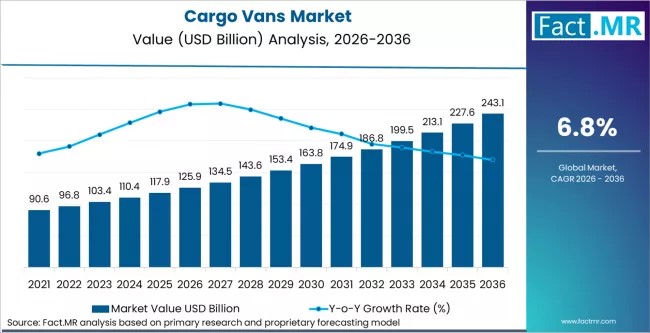
ROCKVILLE, MD, UNITED STATES, March 26, 2026 /EINPresswire.com/ -- In the modern urban landscape, the "last mile" is no longer just a logistical challenge—it is the heartbeat of global commerce. As e-commerce platforms like Amazon, Flipkart, and Alibaba scale their operations, the demand for high-efficiency, urban-optimized light commercial vehicles is reaching an inflection point. The Global Cargo Vans Market is at the center of this structural shift, evolving from a simple goods-carrier into a sophisticated, data-driven, and increasingly electrified mobility asset.According to a comprehensive strategic analysis, the market is valued at USD 125.9 Billion in 2026 and is projected to skyrocket to USD 240.8 Billion by 2036. For fleet procurement officers and automotive OEMs, this represents a massive USD 114.9 Billion absolute dollar opportunity over the next decade.
For Details Deep insights, Please Request A sample report for Free: https://www.factmr.com/connectus/sample?flag=S&rep_id=14520
Quick Stats: The Market Pulse (2026–2036)
Estimated Value (2026): USD 125.9 Billion
Projected Value (2036): USD 240.8 Billion
Forecast CAGR: 6.7%
Dominant Tonnage: 2-to-3 Tons (62.5% market share)
Propulsion Leader: ICE (60% share), though Electric is the fastest-growing segment.
The Executive Mandate: Why Fleet Dynamics are Shifting
For decision-makers, the growth of the cargo van market isn't just about unit sales; it is about the changing economics of urban freight. Three core pillars are driving this 700-word strategic expansion:
The E-Commerce Logistics Boom
Global e-commerce penetration is forcing a rethink of fleet density. In high-growth markets like China (9.2% CAGR) and India (8.7% CAGR), logistics operators are prioritizing the 2-to-3-ton payload class. This "sweet spot" offers the perfect balance between high-volume carrying capacity and the maneuverability required to navigate narrow urban corridors and strict city parking constraints.
The Electric Pivot & Regulatory Pressure
The transition to Electric Cargo Vans is no longer a CSR initiative; it is a regulatory requirement. In Europe, the expansion of Ultra-Low Emission Zones (ULEZ) in cities like London, Paris, and Berlin is mandating a shift away from diesel. Germany (8.0% CAGR) is leading this charge, with major players like DHL and Royal Mail committing to massive electric fleet rollouts. For OEMs, the challenge is balancing high upfront battery costs with a lower Total Cost of Ownership (TCO) that appeals to price-sensitive fleet managers.
Technical Integration: The Smart Van
The modern cargo van is becoming a mobile office. Decision-makers are now looking for integrated telematics that monitor driver behavior, optimize routing in real-time, and track cargo health (especially for high-value or perishable goods). This digital layer is turning the van into a sensor-rich node in the global supply chain, driving a higher replacement frequency for older, "analogue" vehicles.
Regional Growth Hotspots
China (9.2% CAGR): The world’s largest and fastest-growing hub, fueled by government New Energy Vehicle (NEV) subsidies and the aggressive expansion of JD.com and Alibaba’s logistics networks.
United States (6.4% CAGR): A mature market focused on large-scale fleet modernization, particularly through the USPS and Amazon’s Delivery Service Partner (DSP) programs.
Western Europe: France and the UK are emerging as centers for "green" urban delivery, where municipal access rights are increasingly tied to zero-emission vehicle performance.
Strategic Takeaway for Decision Makers
The cargo van market is bifurcating. While Internal Combustion Engine (ICE) vehicles remain the volume backbone for long-haul and rural logistics, the high-margin urban growth is entirely electric. Suppliers and operators who invest in modular platforms—capable of supporting multiple payload configurations from a single chassis—will capture the largest share of the $240 billion future.
For instant access to this report, click “Buy Now” or connect with our analyst for customization: https://www.factmr.com/checkout/14520
To View Related Report:
Automotive Ignition System Market https://www.factmr.com/report/37/automotive-ignition-market
Automotive Fuel Tank Market https://www.factmr.com/report/26/automotive-fuel-tank-market
Automotive Steering System Market https://www.factmr.com/report/43/automotive-steering-system-market
V2X Bidirectional EV Charger Market https://www.factmr.com/report/v2x-bidirectional-ev-charger-market
About Fact.MR
Fact.MR is a global market research and consulting firm, trusted by Fortune 500 companies and emerging businesses for reliable insights and strategic intelligence. With a presence across the U.S., UK, India, and Dubai, we deliver data-driven research and tailored consulting solutions across 30+ industries and 1,000+ markets. Backed by deep expertise and advanced analytics, Fact.MR helps organizations uncover opportunities, reduce risks, and make informed decisions for sustainable growth.
S. N. Jha
Fact.MR
+ +1 628-251-1583
sales@factmr.com
Legal Disclaimer:
EIN Presswire provides this news content "as is" without warranty of any kind. We do not accept any responsibility or liability for the accuracy, content, images, videos, licenses, completeness, legality, or reliability of the information contained in this article. If you have any complaints or copyright issues related to this article, kindly contact the author above.
