

Electronics Films Market Forecast 2026–2036: Market to Reach USD 20.95 Billion by 2036 at 6.3% CAGR
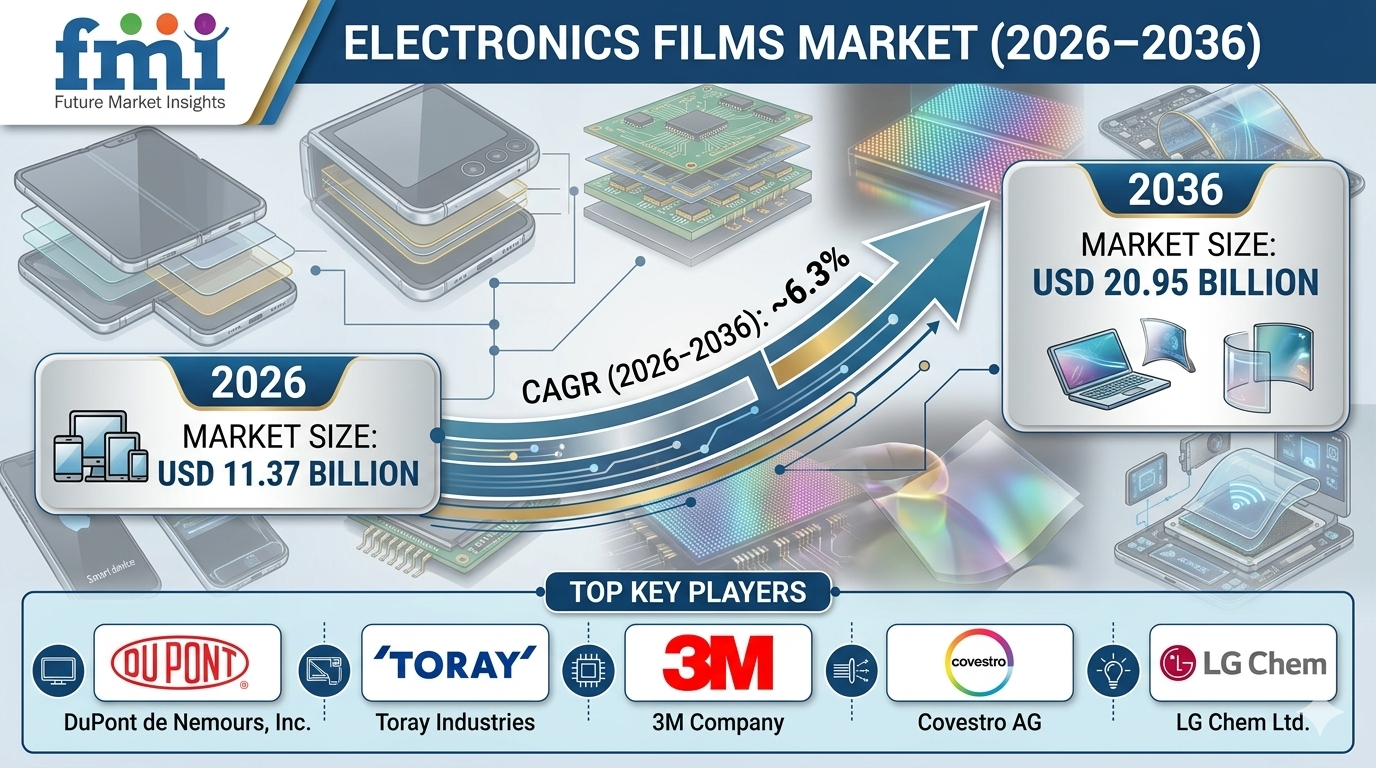
Rising demand for advanced functional films across display, photovoltaic, and flexible electronics applications accelerates global market expansion
NEWARK, DE, UNITED STATES, March 25, 2026 /EINPresswire.com/ -- The global Electronics Films Market is valued at USD 11.37 billion in 2026 and is projected to reach USD 20.95 billion by 2036, expanding at a CAGR of 6.3% from 2026 to 2036. Growth is driven by expanding display panel production, increasing photovoltaic manufacturing capacity, and rapid adoption of flexible electronics across consumer and industrial applications.
As electronic devices evolve toward higher performance, flexibility, and energy efficiency, electronics films are transitioning from passive materials into high-value functional layers—becoming critical enablers in next-generation electronic manufacturing ecosystems.
Electronics Films Market Snapshot (2026–2036)
• Market size in 2026: USD 11.37 billion
• Market size in 2036: USD 20.95 billion
• CAGR (2026–2036): ~6.3%
• Leading material segment: Polymer films
• Top application segment: Displays
• Dominant technology: Deposition techniques (vacuum, sputtering, ALD)
• Fastest-growing country: China
• Key companies: Global advanced materials and specialty film manufacturers
Market Momentum
The Electronics Films Market begins at USD 11.37 billion in 2026, supported by robust demand from display manufacturing and semiconductor packaging. Between 2027 and 2030, OLED panel expansion, micro-LED development, and photovoltaic capacity additions significantly accelerate film consumption.
Entering 2032 and beyond, advancements in atomic layer deposition and roll-to-roll processing enable scalable, high-precision film production. By 2036, the market reaches USD 20.95 billion, with strong momentum driven by diversification into solar energy, smart windows, and printed electronics applications.
Request For Sample Report | Customize Report |purchase Full Report - https://www.futuremarketinsights.com/reports/sample/rep-gb-25812
Why the Market is Growing
The Electronics Films Market is expanding as electronic devices demand higher functionality, miniaturization, and durability. Optical, conductive, and barrier films are essential for maintaining performance standards in displays, semiconductors, and energy systems.
The rise of flexible electronics is a major growth catalyst. Foldable smartphones, wearable devices, and flexible circuits require films with superior mechanical flexibility and dimensional stability under repeated stress conditions.
Additionally, photovoltaic innovation—particularly perovskite-silicon tandem cells—is creating new demand for advanced encapsulation and conductive film layers. These developments extend the role of electronics films beyond traditional applications into renewable energy and smart infrastructure.
Rather than serving as supporting materials, electronics films are now engineered components directly influencing device performance, lifespan, and efficiency.
Segment Spotlight
1. Application: Displays Lead Demand
Displays account for approximately 29.3% of total demand, driven by strong growth in smartphones, televisions, automotive displays, and wearable devices. High-performance films enhance brightness, color accuracy, and durability.
2. Material: Polymer Films Dominate
Polymer films hold around 41.2% of the market share, supported by their flexibility, lightweight properties, and high optical clarity. Materials such as polyimide and polyester are widely used in flexible and high-resolution devices.
3. Technology: Deposition Techniques Remain Core
Deposition technologies contribute about 47.3% of market share, as processes like chemical vapor deposition and atomic layer deposition ensure uniform, high-performance coatings critical for advanced electronics.
Drivers, Opportunities, Trends, Challenges
• Drivers: OLED display expansion, photovoltaic growth, flexible electronics adoption
• Opportunities: Smart windows, printed electronics, advanced solar technologies
• Trends: Roll-to-roll processing, multifunctional coatings, flexible substrates
• Challenges: High-purity raw material constraints, cost pressures, complex qualification processes
Country Growth Outlook (2026–2036)
China leads growth at a projected 8.5% CAGR, driven by large-scale OLED fabrication and solar manufacturing expansion. India follows at 7.9%, supported by electronics manufacturing growth and solar initiatives. Germany (7.2%) benefits from automotive electronics demand, while France (6.6%) and the UK (6.0%) expand through innovation in flexible electronics and smart technologies. The United States maintains steady growth at 5.4%, and Brazil records 4.7% driven by photovoltaic and electronics assembly expansion.
Competitive Landscape
The market features leading advanced material manufacturers competing on film performance, coating precision, and application-specific customization. Companies are investing in high-purity raw materials, advanced deposition technologies, and scalable production systems.
Key players such as DuPont de Nemours, Inc., Toray Industries, 3M Company, Covestro AG, and LG Chem Ltd. are focusing on innovation, product diversification, and strategic partnerships to strengthen market presence.
Competition is increasingly centered on optical performance, thermal stability, electrical conductivity, and the ability to deliver consistent quality across high-volume manufacturing environments.
Frequently Asked Questions (FAQ)
What is the global Electronics Films Market size?
The market is valued at approximately USD 11.37 billion in 2026 and is projected to reach USD 20.95 billion by 2036.
At what rate is the market expected to grow?
The market is forecast to expand at a CAGR of about 6.3% from 2026 to 2036.
What are electronics films?
Electronics films are thin-film materials that provide optical, electrical, thermal, or protective functionality in electronic devices, including displays, semiconductors, and photovoltaic systems.
Why are electronics films gaining importance?
They enable enhanced device performance, flexibility, energy efficiency, and durability while supporting innovation in flexible electronics, renewable energy, and advanced display technologies.
Explore More Related Studies Published by FMI Research:
Composite Grade PCR for Decorative & Structural Surfaces Market https://www.futuremarketinsights.com/reports/composite-grade-pcr-for-decorative-structural-surfaces-market
Calcite Market https://www.futuremarketinsights.com/reports/calcite-market
Reinforced Concrete Additives Using PCR Fibers Market https://www.futuremarketinsights.com/reports/reinforced-concrete-additives-using-pcr-fibers-market
About Future Market Insights (FMI)
Fture Market Insights, Inc. (FMI) is an ESOMAR-certified, ISO 9001:2015 market research and consulting organization, trusted by Fortune 500 clients and global enterprises. With operations in the U.S., UK, India, and Dubai, FMI provides data-backed insights and strategic intelligence across 30+ industries and 1200 markets worldwide.
Why Choose FMI: https://www.futuremarketinsights.com/why-fmi
Sudip Saha
Future Market Insights Inc.
347-918-3531
rahul.singh@futuremarketinsights.com
Legal Disclaimer:
EIN Presswire provides this news content "as is" without warranty of any kind. We do not accept any responsibility or liability for the accuracy, content, images, videos, licenses, completeness, legality, or reliability of the information contained in this article. If you have any complaints or copyright issues related to this article, kindly contact the author above.
