

IV Bag Market Growth 2026–2036: Market to Reach USD 3.8 Billion by 2036 at 6.1% CAGR
IV Bag Market
USA IV container sales will grow at 5.0% CAGR through 2036, driven by chronic care demand, premixed solutions, advanced infusion therapies, and supply chains.
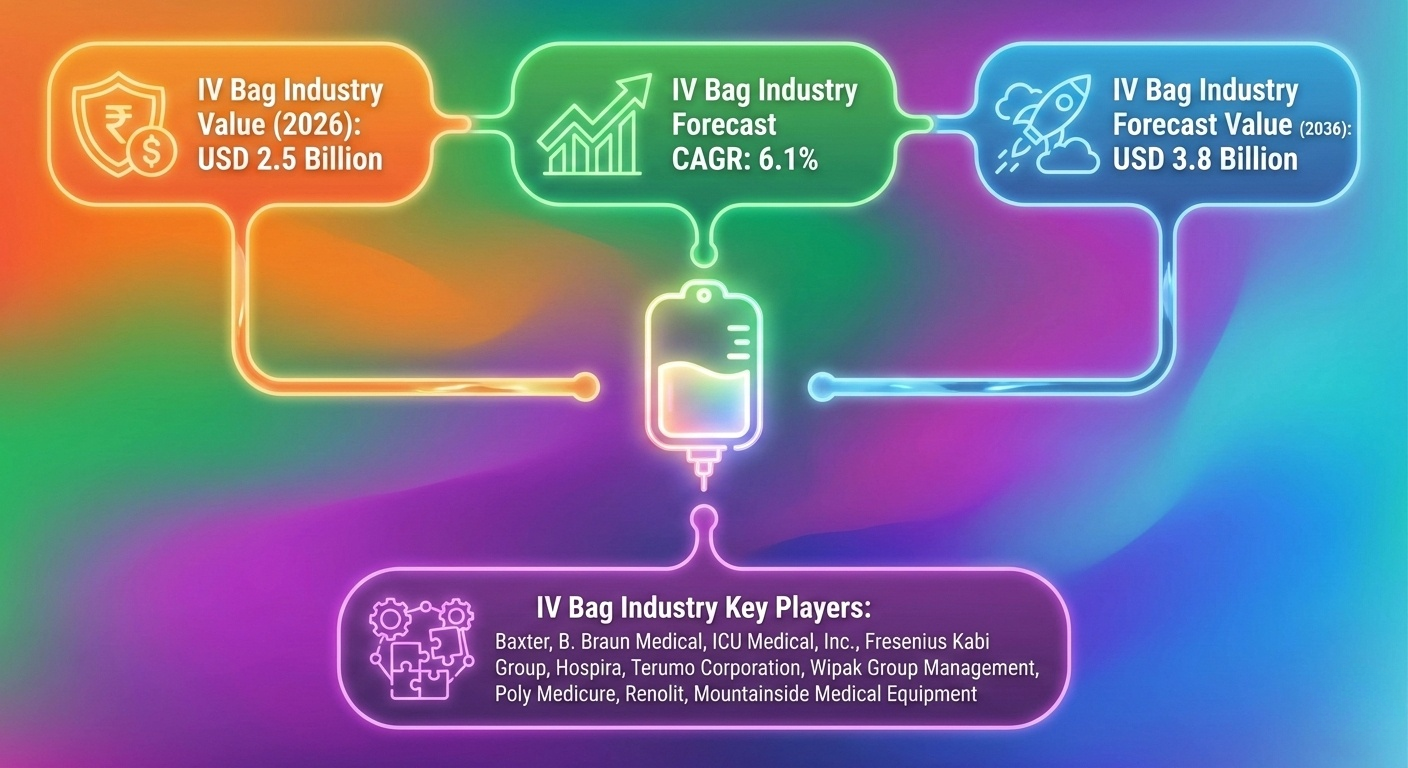
NEWARK, DE, UNITED STATES, February 20, 2026 /EINPresswire.com/ -- The global IV Bag market is projected to reach USD 2.5 billion in 2026 and expand at a steady 6.1% CAGR through 2036, ultimately surpassing USD 3.8 billion by the end of the assessment period. The growth trajectory reflects a combination of rising chronic disease burden, increasing reliance on parenteral nutrition and hydration, and structural shifts in hospital procurement patterns.
According to analysis by Future Market Insights (FMI), the sector is undergoing material, technological, and operational transformation as manufacturers respond to stricter safety regulations, evolving treatment protocols, and the expansion of home-based care.
Quick Market Statistics
• Industry Value (2026): USD 2.5 Billion
• Forecast Value (2036): USD 3.8 Billion
• CAGR (2026–2036): 6.1%
• Leading Form: Single chamber IV bags (58%)
• Leading Application: Intravenous therapies (60%)
• Leading Material: PVC (46%)
Discover Growth Opportunities in the Market – Get Your Sample Report Now
https://www.futuremarketinsights.com/reports/sample/rep-gb-3580
Market Overview: What Is Driving Growth?
The IV bag industry plays a critical role in intravenous therapies and parenteral nutrition. In 2026, single chamber IV bags account for 58% of total market share, while intravenous therapies represent 60% of end-use demand. Polyvinyl chloride (PVC) remains the leading material, holding 46% share, though a shift toward alternative polymers is accelerating.
Key growth regions include India, China, and the United States, where healthcare infrastructure investments and disease prevalence patterns are reinforcing demand for safe, reliable fluid delivery systems.
Transition to Non-PVC Materials Reshapes Manufacturing
A defining structural shift in the IV bag market is the movement away from DEHP-containing PVC toward polypropylene (PP) and polyethylene (PE)-based films. These advanced materials, while averaging 15–20% higher costs than traditional PVC, are increasingly necessary to comply with EU MDR and US FDA safety guidelines concerning plasticizers.
However, this transition has implications beyond material selection. Polyolefins do not respond efficiently to conventional radio-frequency (RF) welding systems used for PVC. As a result, manufacturers are investing in thermal contact or laser welding technologies, increasing capital expenditure—particularly for legacy producers.
The shift toward non-PVC materials is further supported by:
• Reduced risk of DEHP leaching
• Improved drug compatibility in oncology
• Incineration-safe environmental profiles
• Growing procurement preference from pediatric and neonatal units
Premixed Drug Formulations Redefine Hospital Procurement
Hospitals are increasingly moving from standard saline bags to ready-to-administer (RTA) premixed formulations, reducing medication errors by approximately 30%. This transition is prompting converters to develop multi-chamber IV bag portfolios with peelable seals that separate unstable components until administration.
Yet, sterilization remains a bottleneck. Heat-sensitive amino acids and lipids cannot withstand conventional steam autoclaving at 121°C. Manufacturers must invest in aseptic filling lines or lower-temperature sterilization technologies, significantly increasing production cycle time and operational complexity.
Efficient production cycle management is therefore essential. Optimizing autoclave load configurations and cool-down periods directly influences throughput and cleanroom asset utilization.
Operational Performance: Margins, Inventory, and Resin Supply
Gross margins in the IV bag sector typically range between 35% and 45%, though they remain sensitive to petrochemical price volatility. Vertically integrated manufacturers with in-house film extrusion capabilities are better positioned to protect margins.
Supply chain resilience is another strategic priority. Dependence on specific medical-grade resin grades creates vulnerability. Leading players are establishing dual-source agreements for PVC and PP resins to prevent production stoppages during petrochemical fluctuations.
Inventory turnover ratios are especially critical for premixed drug bags, which have shorter shelf lives than empty containers. Efficient turnover ensures timely hospital delivery and reduces expiry risks—particularly important for emergency and pressure infusion bag distributors.
Home Healthcare and Smart Compatibility Influence Design
The rise of ambulatory care and home infusion therapy is redefining IV bag design priorities. Portable, durable fluid containers compatible with infusion pumps are increasingly demanded. Manufacturers are integrating:
• Self-sealing ports for infection control
• Smart pump-compatible hanging systems
• Barcode labeling for medication tracking
• Multi-layer laminates to prevent oxidation
Clinical trials supporting home-based chemotherapy are further expanding demand for high-durability elastomeric bags.
Sustainability Becomes a Competitive Differentiator
Hospital waste management costs and environmental mandates are reshaping material strategies. The adoption of PVC-free, recyclable, or reduced-plastic solutions aligns with circular economy objectives and “Green OT” certifications.
Manufacturers offering lifecycle assessment data and take-back programs are gaining competitive advantage. Failure to optimize environmental impact could reduce visibility among sustainability-driven procurement committees.
Regional Growth Patterns (2026–2036 CAGR)
• India: 7.2%
• China: 7.0%
• United States: 5.0%
• Germany: 4.6%
• Japan: 3.3%
Competitive Landscape and Industry Consolidation
Market participants are increasingly pursuing vertical integration from resin extrusion to final filling—to secure supply and margin stability. Strategic collaborations with pharmaceutical companies for premixed drug bags are intensifying.
Baxter holds an estimated 14% market share, leveraging its diversified renal and hospital portfolio. Other key players include:
• B. Braun Medical
• ICU Medical, Inc.
• Fresenius Kabi Group
• Hospira
• Terumo Corporation
• Wipak Group Management
• Poly Medicure
• Renolit
• Mountainside Medical Equipment
Consolidation remains active as larger med-tech conglomerates acquire regional manufacturers to expand capacity and mitigate supply risks.
Why FMI: https://www.futuremarketinsights.com/why-fmi
Have a Look at Related Research Reports on the Packaging Domain:
Global Luxury Packaging Market https://www.futuremarketinsights.com/reports/luxury-packaging-market
PET Bottles Market https://www.futuremarketinsights.com/reports/pet-bottles-market
PDCL Film Market https://www.futuremarketinsights.com/reports/pdcl-film-market
Folding Boxboard Market https://www.futuremarketinsights.com/reports/folding-boxboard-market
About Future Market Insights (FMI)
Future Market Insights, Inc. (FMI) is an ESOMAR-certified, ISO 9001:2015 market research and consulting organization, trusted by Fortune 500 clients and global enterprises. With operations in the U.S., UK, India, and Dubai, FMI provides data-backed insights and strategic intelligence across 30+ industries and 1200 markets worldwide.
Sudip Saha
Future Market Insights Inc.
+1 347-918-3531
email us here
Legal Disclaimer:
EIN Presswire provides this news content "as is" without warranty of any kind. We do not accept any responsibility or liability for the accuracy, content, images, videos, licenses, completeness, legality, or reliability of the information contained in this article. If you have any complaints or copyright issues related to this article, kindly contact the author above.
