

Precision Ophthalmic Gas Delivery Market Set to Reach USD 1,431.0 Million by 2036
Ophthalmic Gas Delivery Market
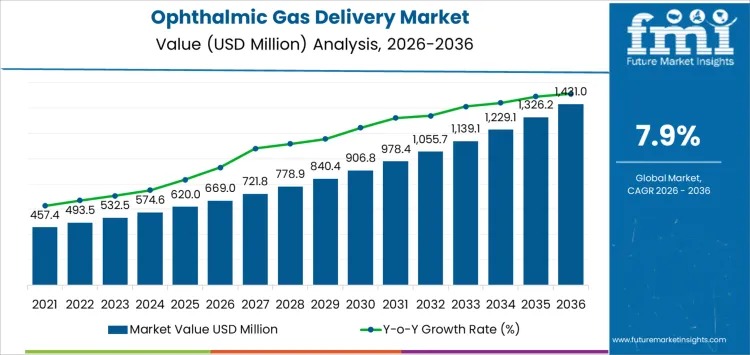
The ophthalmic gas delivery market is projected to grow from USD 669.0 million in 2026 to USD 1,431.0 million by 2036, at a CAGR of 7.9%.
NEWARK, DE, UNITED STATES, January 16, 2026 /EINPresswire.com/ -- The global Ophthalmic Gas Delivery Market is poised for significant structural expansion, with its valuation expected to rise from USD 668.98 million in 2026 to USD 1,431.0 million by 2036, according to the latest market analysis. Representing a compound annual growth rate (CAGR) of 7.90%, the sector is increasingly recognized as a cornerstone of modern vitreoretinal care, where surgical precision and execution reliability are the primary determinants of patient outcomes.
As retinal surgery capacity expands globally, the demand for medical gases—primarily Sulfur Hexafluoride (SF6) and Perfluoropropane (C3F8)—has transitioned from discretionary purchasing to a structural necessity. This shift is driven by the rising prevalence of age-related retinal conditions, diabetic retinopathy, and the global standardization of operating room (OR) workflows.
Reliability Over Price: The Shift in Buyer Intent
In the high-stakes environment of vitreoretinal surgery, hospital procurement strategies are evolving. Decision-makers at leading hospitals and Ambulatory Surgery Centers (ASCs) are increasingly prioritizing delivery accuracy and regulatory compliance over short-term pricing advantages.
“The market is fundamentally execution-driven,” notes the industry report. “Buyer intent is centered on minimizing intraoperative risk and avoiding workflow disruption. Institutions are consolidating vendors to simplify inventory management and ensure that surgical teams have access to validated, sterile, and high-purity delivery systems.”
Request For Sample Report | Customize Report |purchase Full Report - https://www.futuremarketinsights.com/reports/sample/rep-gb-31371
Product Analysis: Why SF6 Systems Lead Adoption
SF6 (Sulfur Hexafluoride) gas systems currently command a 42% share of the market. This dominance is attributed to the gas’s unique physical properties:
• Optimal Tamponade Duration: SF6 provides a short-to-medium term intraocular tamponade, offering a balanced resorption timeline that reduces the risk of long-term postoperative complications.
• Predictable Expansion: Surgeons prefer SF6 for its reliable expansion characteristics, which are critical for maintaining intraocular pressure (IOP) during the healing phase of retinal reattachment.
• Ease of Integration: Compatibility with standard delivery accessories makes SF6 the "gold standard" for routine vitrectomies and pneumatic retinopexy.
Application Insights: Retinal Detachment Surgery
Accounting for 58% of application demand, retinal detachment surgery remains the primary driver of gas consumption. As internal pressure is required to support retinal healing following vitrectomy or scleral buckling, gas tamponade is a clinical necessity. The increasing incidence of trauma-related detachments and age-related foveal issues ensures a consistent, volume-driven demand for these delivery systems.
Global Outlook: Emerging High-Growth Corridors
While the United States remains a mature and steady market (8.6% CAGR), the Asia-Pacific region is emerging as the fastest-growing geographical segment.
• India (9.6% CAGR): Rapidly expanding eye-care infrastructure and a high patient throughput in private specialty clinics make India the global growth leader.
• China (9.4% CAGR): Significant investments in regional medical centers and a scaling elderly population are driving massive surgical volumes.
• Brazil (8.8% CAGR): Increased access to advanced ophthalmic surgeries in urban centers is fueling demand for cost-effective, reliable gas delivery solutions.
• Germany (7.2% CAGR): Characterized by rigorous regulatory oversight, the German market emphasizes clinical documentation and patient safety standards.
Challenges to Market Expansion
Despite the optimistic growth forecast, the market faces headwinds. Stringent regulatory requirements for medical-grade gas production and the complexity of distribution logistics—including maintaining gas integrity and pressure safety—can restrain rapid expansion. High purity standards and the need for specialized clinician training remain barriers to entry for new providers, particularly in resource-limited regions.
Competitive Landscape: Precision and Control
Innovation in the sector is being led by a core group of industry giants and specialized instrument manufacturers.
• Alcon and Bausch + Lomb continue to lead through integrated surgical platforms that emphasize calibrated delivery and consistent intraocular behavior.
• Dutch Ophthalmic (D.O.R.C.) and Geuder AG differentiate through ergonomic delivery instruments designed to minimize intraocular fluctuations.
• Rumex International focuses on the seamless integration of gas delivery systems with ancillary vitrectomy tools.
As the industry moves toward 2036, the "trust-based" model of supplier selection will remain paramount. For manufacturers, success will depend on their ability to offer validated dosing accuracy and comprehensive handling support to surgical teams worldwide.
Similar Industry Reports
Gas Delivery Systems Market
https://www.futuremarketinsights.com/reports/gas-delivery-systems-market
Gastro-retentive Drug Delivery Systems Market
https://www.futuremarketinsights.com/reports/gastro-retentive-drug-delivery-systems-market
Dual Fuel Diesel Gas Fuel Delivery Market
https://www.futuremarketinsights.com/reports/dual-fuel-diesel-gas-fuel-delivery-market
Sudip Saha
Future Market Insights Inc.
+1 347-918-3531
email us here
Legal Disclaimer:
EIN Presswire provides this news content "as is" without warranty of any kind. We do not accept any responsibility or liability for the accuracy, content, images, videos, licenses, completeness, legality, or reliability of the information contained in this article. If you have any complaints or copyright issues related to this article, kindly contact the author above.
